
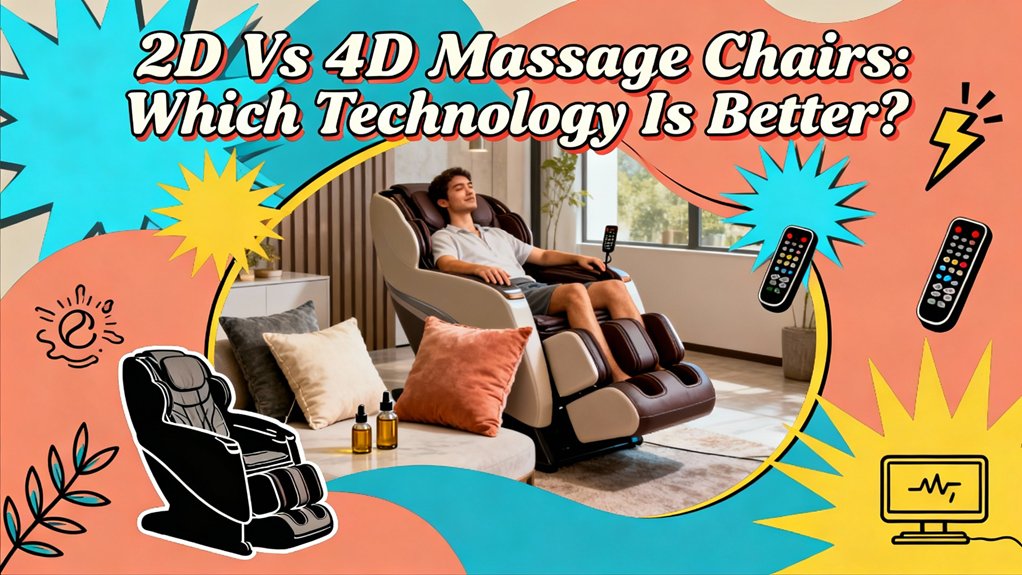
You’ll find that 4D massage chairs deliver superior therapeutic outcomes compared to 2D models. While 2D chairs execute only fixed vertical and horizontal motions with consistent pressure, 4D technology automatically adjusts roller speed and depth, mimicking a skilled therapist’s precision. 4D chairs incorporate AI body scanning, personalized profiles, and 24 airbags for inclusive coverage from neck to glutes. They concentrate intensity on problem areas with advanced pressure sensors, offering rehabilitation functions and wellness tracking capabilities. Understanding how these technologies translate into real performance differences reveals why the investment matters.
Understanding 2D Massage Chair Technology
If you’re considering a massage chair, you’ll want to understand what “2D” actually means—it’s a specification that describes how the chair’s rollers move. In 2D technology, rollers operate along two axes: vertical (up-and-down) and horizontal (side-to-side). They track your spine’s S-curve from neck to lower back, delivering consistent pressure without depth adjustment.
You’ll find user experience customization limited to speed variations, which alter massage intensity through roller velocity. The fixed protrusion level means you can’t control how deeply rollers penetrate muscle tissue. To get the most from your 2D chair, it’s important to start with shorter 15-minute sessions to allow your body to adjust to the massage.
However, this straightforward design offers substantial advantages. The simplified mechanics enhance hardware durability, reducing mechanical failures and maintenance costs. A microprocessor coordinates the chair’s components to ensure consistent performance. You’ll experience reliable, uniform pressure application—ideal if you prefer predictable, steady massage sensations without complex adjustments. Studies have shown that consistent massage therapy can contribute to stress reduction and improved well-being. 2D chairs provide basic up-and-down massage motion that remains effective for general relaxation purposes. These chairs deliver therapeutic relief through their fundamental roller systems that have proven effective for decades. Most massage chairs originally featured 2D technology before post-2015 innovations introduced advanced mechanisms like 3D and 4D systems.
Exploring 4D Massage Chair Technology
As massage chair technology has evolved, 4D systems build on their 3D predecessors by introducing a fourth dimension: variable speed and rhythm. You’ll experience rollers that adjust pace dynamically, mimicking how a human masseuse changes tempo during treatment.
4D chairs feature automated sensing capabilities that scan your body’s contours and create personalized profiles. This technology enables real-time pressure and speed modifications, delivering deeper tissue adaptation than fixed 3D motions allow. Premium models incorporate 24 airbags with multiple air cells to complement roller movements with comprehensive air compression massage throughout the chair.
With customizable programming, you can select pre-programmed routines replicating Swedish, Shiatsu, or deep tissue techniques. The chair automatically accelerates and decelerates through targeted muscle groups, creating a fluid, natural massage experience. These dynamic adjustments simulate the nuanced techniques that professional masseuses use to deliver highly personalized treatments. L- and SL-track designs extend massage coverage from neck to glutes, ensuring comprehensive full-body relief. Advanced models like the Bodyfriend Falcon SV feature zero gravity recline positioning to enhance the therapeutic benefits of massage therapy.
Advanced AI in premium models continuously adjusts intensity, providing spa-like responsiveness that adapts to your body’s specific needs throughout each session. Like the Inada DreamWave’s DreamWave technology, top-tier 4D chairs incorporate innovative motion systems that create side-to-side movements enhancing spinal alignment alongside their advanced roller and airbag capabilities. Entry-level 4D alternatives like the KoziSense A18 offer impressive value by combining 3D roller technology with automated body scanning and customizable massage programs for accessible home spa experiences.
Movement and Motion Capabilities Compared
The fundamental difference between 2D and 4D massage chairs lies in their movement complexity and adaptive capabilities. Your 2D chair executes fixed vertical and horizontal roller motions at consistent speeds, prioritizing broad surface coverage without depth variation. Conversely, 4D models incorporate sophisticated robotic motion capabilities that automatically adjust roller speed and depth throughout massage sequences.
You’ll experience how 4D technology’s performance attributes dynamically concentrate intensity on problem areas. These chairs employ Japanese-developed algorithms analyzing thousands of professional massage techniques, enabling them to accelerate and decelerate at appropriate intervals. Your 4D chair mimics nuanced therapist hand variations through depth control combined with multi-speed modulation—up to five distinct settings on premium models. This automation eliminates manual adjustment requirements, delivering targeted pressure application that 2D static settings cannot replicate. Additionally, 4D chairs feature body scanning technology that personalizes the massage experience by adapting to your unique body shape and massage preferences. Premium 4D models also offer AI adaptive programming that continuously learns your preferences to optimize each massage session. Beyond traditional massage functions, advanced 4D chairs incorporate precision pressure sensors that enable real-time adaptive pressure mimicking human hands for enhanced therapeutic benefits. The Synca JP1100 exemplifies this technology with its 4D massage roller robot designed for deep-tissue therapy and comprehensive full-body treatment. Leading manufacturers like Fujiiryoki and Bodyfriend have integrated robot-like AI capabilities that enable rehabilitation functions and personalized wellness tracking beyond traditional massage functions. Innovative models featured at CES 2026, such as Bodyfriend’s 733 AI-powered chair, demonstrate how cutting-edge massage technology now incorporates bipedal movement and app-controlled exercises for advanced therapeutic benefits.
Depth Control and Pressure Variations
Depth control represents where 2D, 3D, and 4D massage chairs diverge most substantially in their therapeutic capabilities. With 2D technology, you’re confined to surface-level massage since rollers move only horizontally and vertically. You’ll sacrifice precision targeting and experience fixed intensity unsuitable for deep tissue work.
3D chairs introduce variable protrusion, extending rollers 2.2 to 4.7 inches. This advancement grants you granular intensity control through manual adjustment, enabling precise muscle and knot targeting. You can customize pressure based on individual needs. Many 3D models feature accurate body scanning to determine your shape, size, and height for optimized massage personalization.
4D systems automate this process using variable speed technology. You’ll experience dynamic pressure changes that replicate human massage techniques without manual intervention. Premium 4D models often integrate heat therapy alongside their depth control capabilities for enhanced therapeutic benefits. The advanced SL/L-Track design found in leading models spans up to 53 inches, delivering comprehensive massage coverage from neck to thighs. Leading manufacturers like Osaki and Human Touch have pioneered heated 4D rollers that combine advanced depth control with therapeutic warmth for superior relaxation outcomes. Osaki’s advanced 4D rollers mimicking human hands deliver customizable deep tissue massages that adapt to your specific tension areas. For you seeking a personalized massage experience that adapts intelligently to tension areas, 4D delivers superior therapeutic effectiveness through rhythmic intensity variations.
Speed, Rhythm, and Dynamic Adjustments
While depth control distinguishes 2D chairs through fixed positioning, speed and rhythm represent where 4D technology truly elevates the massage experience through intelligent motion adaptation.
You’ll find 4D chairs employ variable speeds that dynamically shift during massage strokes, mimicking human therapist techniques with ergonomic efficiency. Rollers accelerate at stroke tops and decelerate at endpoints, creating natural flow patterns. This automatic speed modulation targets tense muscles without requiring manual adjustments, enabling therapeutic synergy between intensity and timing. Premium 4D models like the Infinity Dynasty 4D feature preset voice commands that allow users to activate these dynamic adjustments hands-free. Models such as the Human Touch Super Novo X incorporate Intellitrack body sensing technology that automatically detects shoulder positioning and adapts massage patterns in real time. The zero-gravity recline position found in advanced 4D chairs like the D.Core 2 further enhances therapeutic outcomes by optimizing spinal alignment during deep-tissue massage sessions.
Conversely, 2D chairs offer only consistent, preprogrammed rhythms—kneading, tapping, and rolling patterns lacking mid-stroke variations. You’re limited to manual speed tweaks that adjust overall intensity uniformly, producing more robotic sensations. Advanced 4D massage chairs incorporate 24 airbags that work in conjunction with dynamic roller movements to deliver comprehensive full-body compression massage. The in and out movement of 3D and 4D chairs further enhances precision by allowing rollers to penetrate deeper into muscle tissue layers. Leading models like the OHCO M.8 NEO showcase how 4D precision and tri-zone heat integration create more sophisticated therapeutic outcomes.
While industry standardization remains inconsistent across 4D brands, the automatic rhythm adjustments embedded in 4D programs deliver superior nuanced pacing and deeper muscle relief compared to 2D’s static speed variables.
Coverage Area and Target Muscle Groups
Beyond the rhythmic sophistication that 4D chairs deliver, you’ll notice their mechanical advantages become even more pronounced when examining how each technology covers your body’s muscle groups. 2D massage chairs constrain rollers to vertical and horizontal movement along a single plane, effectively limiting their reach to surface-level back, neck, and shoulder muscles through basic kneading, tapping, and rolling patterns. Conversely, 4D systems extend outward up to 5 inches, penetrating deeper muscle layers like your erector spinae and trapezius with rotational capability. The automatic width adjustment from 3cm to 21cm guarantees body shape conformity, while independent top and bottom roller protrusion delivers anatomical precision targeting specific tension zones. You’ll experience thorough coverage that 2D technology simply can’t replicate, mimicking authentic human-hand massage across your entire musculature. Premium 4D models like the iBooMas P03 and EasPearl R8089 PRO feature heated 4D rollers that enhance therapeutic efficacy for deeper tissue penetration. Japanese manufacturers like Fujiiryoki have pioneered advanced roller technology that sets the standard for precision massage in premium recliners, with elite models incorporating features such as zero gravity positioning to maximize therapeutic benefits. Leading brands now incorporate automatic body scanning to ensure optimal pressure distribution across all targeted areas, a feature also found in premium Ogawa models like the Master Drive AI 2.0. 4D chairs are particularly advantageous for chronic pain conditions due to their advanced depth and speed variation capabilities.
Price Points and Budget Considerations
When evaluating massage chair investments, you’ll find the pricing landscape reflects a clear hierarchy across dimensional technologies. 2D chairs establish the entry point, starting around $2,000 for basic models and remaining the most affordable option even as 4D systems drop in price—most budget 2D offerings stay under $3,000.
4D models typically exceed $5,000, though discounted units now reach $6,000 from original $13,000 prices. You’ll uncover 3D chairs bridge this gap, available just under $3,000 with competitive options under $5,000. 3D chairs also offer more features like voice control, heat therapy, and zero gravity positioning.
For budget performance, 2D delivers zero-gravity positioning and basic scanning technology without premium costs, suiting occasional users and first-time buyers. Sub-$1,000 models like the Mazzup MU-C311 demonstrate that affordable options increasingly include legitimate features such as air compression massage and heat therapy capabilities. The Synca Wellness CirC exemplifies this trend with 2D quad-style rollers and an L-track available around $1,200 or less on sale. Budget massage chairs like the BestMassage EC 06C also provide S-track rollers and heated roller functionality at accessible price points for casual users. Even more budget-friendly portables like shiatsu massage devices under $200 provide basic relief for cost-conscious consumers. Premium luxury chairs exceeding $10,000 provide advanced 4D mechanisms designed to last 10+ years, making them a cost-effective alternative to frequent professional massages. However, if you need deep pressure relief, 4D’s sale pricing justifies the upgrade. You should evaluate whether 4D’s advanced capabilities justify the premium over 2D’s budget features and affordability.
Best Use Cases for Each Technology
Your choice between 2D and 4D massage chairs should align with your specific wellness objectives and lifestyle constraints. If you’re seeking healthy lifestyle options for general stress relief and basic muscle fatigue, 2D chairs deliver adequate wellness benefits through consistent kneading and rolling motions. They’re ideal when space limitations matter or you need affordability. Models with SL-track technology provide extended coverage that bridges traditional designs for those wanting enhanced reach without 4D complexity.
Conversely, 4D technology suits you if you’re managing chronic pain, arthritis, or fibromyalgia requiring advanced customization. Athletes benefit from 4D’s targeted recovery capabilities and intensity adjustments that replicate professional techniques. You’ll also appreciate 4D’s real-time adjustments for complex tension patterns that basic motion can’t address. Elite massage chairs featuring 4D massage technology provide customizable experiences that address intricate wellness needs beyond standard motion capabilities. Top models like the Osaki DuoMax and Titan Ronin incorporate L-track systems that extend massage coverage along the entire spine for comprehensive therapeutic benefits. Premium 4D models like the Osaki AmaMedic Hilux combine heated rollers with SL-track systems for deep tissue relief from neck to glutes. Advanced chairs such as the Osaki Pro OS-3D Opulent feature 3D massage mechanisms with rollers moving along multiple axes to target specific muscle groups effectively. The majority of the market still consists of 2D massage chair models, making them widely accessible and proven options for consumers prioritizing value without sacrificing core therapeutic benefits.
Consider your primary wellness goals: general relaxation favors 2D, while therapeutic intervention and athletic recovery warrant 4D’s sophisticated capabilities.
Long-Term Value and Investment Return
Evaluating massage chair investments requires analyzing not just upfront costs but the total economic benefit across ownership years. Your return on investment analysis reveals that 4D chairs justify their premium pricing through superior cost saving benefits. While 2D models cost less initially, they depreciate rapidly due to limited motion capabilities, yielding poor resale value retention.
4D chairs offset higher upfront expenses by reducing spa visits through customizable, professional-grade sessions that replicate therapist techniques. Their dynamic speed adjustments and specialized roller designs eliminate manual tweaking, maximizing session efficiency and therapeutic outcomes. Rollers mounted on precision motors enable consistent performance that maintains therapeutic quality throughout the chair’s lifespan. Over five to seven years, you’ll recover the investment differential through decreased spa expenditures and consistent performance. 3D chairs occupy the middle ground, offering better longevity than 2D while providing moderate long-term savings. Your choice depends on usage frequency and therapeutic priorities.


